Carnet à couverture fleurie de Louise
Chanson douceLouise’s flower-covered notebook is both a private record and a rare material trace of her inner life: in it she writes down the hospital doctor’s phrase “Mélancolie délirante,” finding an unexpected poetic escape in the name for her suffering. Later, Nina Dorval reads the notebook as part of her effort to understand Louise, but its strange letters and unfamiliar names deepen the sense of a life that remained difficult for others to enter.
A Private Record of Distress
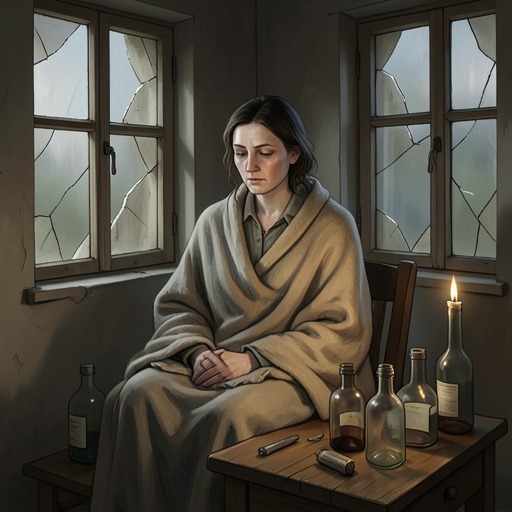
During a period of severe distress, Louise writes the words “Mélancolie délirante” in the small notebook with a flowered cover. The phrase comes from a doctor at Henri-Mondor Hospital, where Louise had been admitted for mood disorders. Rather than record the diagnosis as merely clinical information, she responds to its sound and appearance: she finds it beautiful, and a touch of poetry and escape enters her sadness.
The notebook’s physical form matters to this act of naming. Louise writes in a strange hand, with crooked, emphatic capital letters. On its pages, the words resemble the unstable wooden structures Adam builds for the pleasure of watching them collapse. The comparison places the notebook between expression and fragility: it holds Louise’s words, but their precarious appearance echoes constructions that are made to fall apart.
What the Pages Preserve
The notebook offers evidence of Louise’s attention to words and names, while leaving much of their meaning uncertain. Its pages contain names unknown to Nina, written with the application of a solitary child. The record is therefore intimate but not transparent: it preserves traces of Louise’s associations without making them readily legible to another person.
That opacity stands against the absence of a private room in Louise’s life. In her distress, she is haunted by the feeling that she has seen and heard too much of other people’s intimacy, though she was never entitled to such intimacy herself; she had never had a room of her own. The notebook is a small private space in written form, but its contents do not resolve the isolation that produced it.
Nina Dorval’s Reading
After two months investigating Louise, Nina Dorval reads the flower-covered notebook for hours. She dreams of its crooked letters and unfamiliar names, drawn into the record even as she cannot fully decipher it. Her attention is part of a wider search: she questions people who knew or encountered Louise, including the Rouvier family, M. Franck, Mme Perrin, hospital doctors, former neighbors, and nannies at the square. Their accounts offer little intimacy or insight.
The notebook thus becomes an object of attempted witnessing. Nina wants to know Louise through what she has left behind, but the pages do not turn that effort into certainty. Their careful, childlike marks preserve a voice and the fact of its loneliness; they also show how much remains inaccessible, even after exhaustive inquiry.